
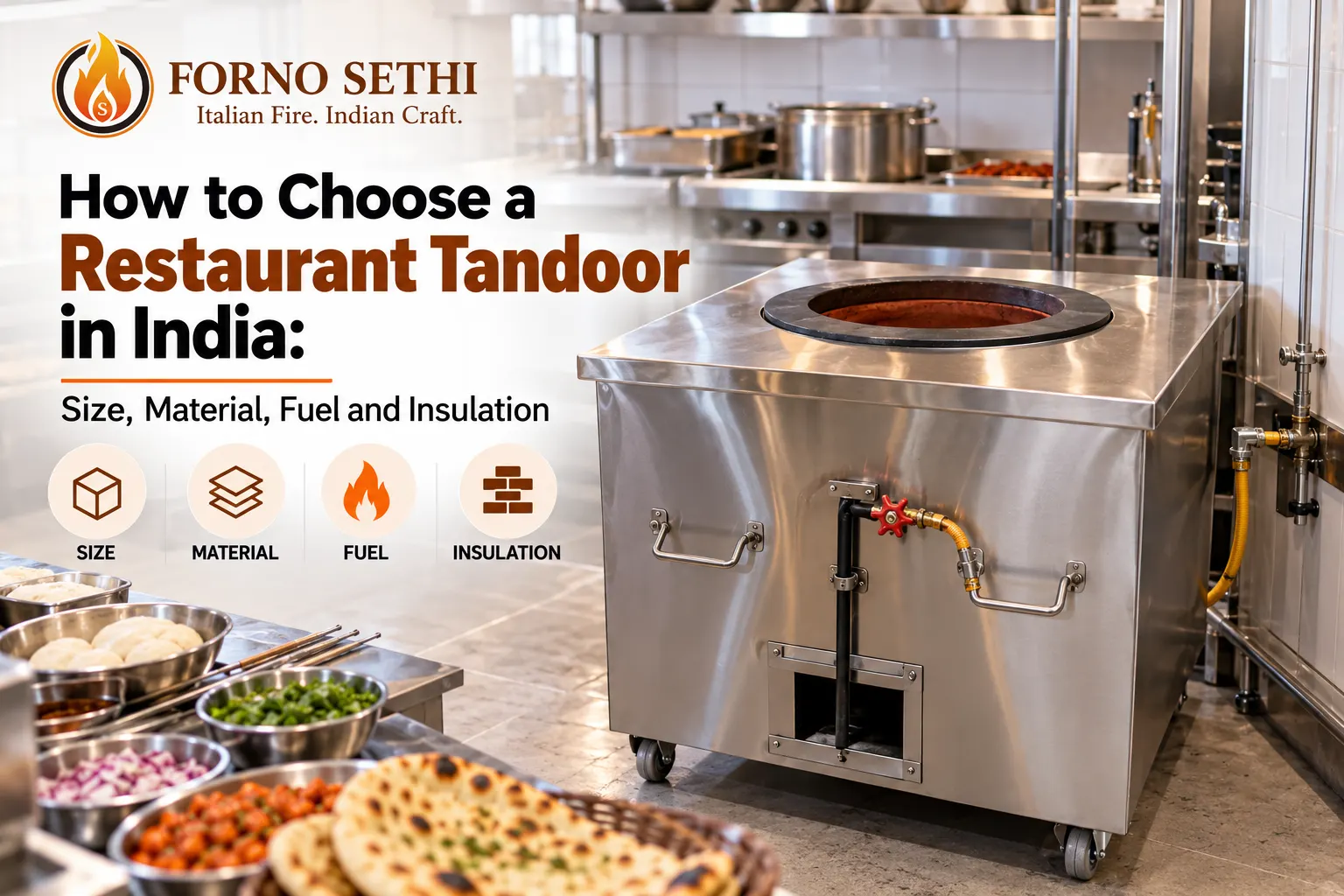
Quick answer
- Size: the clay chamber is the same across our commercial sizes, so one tandoor gives the same batch size. Choose the outer size for your counter space; add a second tandoor for more volume.
- Fuel: charcoal is the default across India. Choose gas (LPG or PNG) where pollution rules restrict coal. Choose electric where open flame or fuel is not allowed, such as malls and high-end hotels.
- Body: SS for guest-facing kitchens, MS for budget or heavy-use catering. Ask for the grade and thickness in writing.
- Insulation and support: they decide whether the tandoor is still a good buy five years from now.
By Anshul Sethi, Founder, Forno Sethi, Delhi. Last updated: 29 October 2026. Reading time: about 9 minutes.
Why most restaurant owners buy the wrong tandoor the first time
A tandoor looks simple: a clay pot inside a body. So buyers compare only the price and the outer dimensions. The mistakes we hear about most often come from somewhere else: a tandoor that is too small for the dinner rush, a fuel that the local rules do not allow, a body that is rusting in the second year, or a chamber that cracked because nobody told the cook how to heat it.
This guide goes through the decision in the same order we walk a buyer through it on a phone call.
Step 1: Work out your peak-hour demand
Do not size a tandoor by the number of seats. Size it by what leaves the kitchen in your busiest hour. Write down:
- How many naan, roti or kulcha you sell in the busiest hour.
- How many skewers (tikka, kebab, paneer, chaap) go out in the same hour.
- Whether one cook handles bread and skewers together, or you run two tandoors.
One thing most buyers miss: in a commercial tandoor, a bigger outer size does not mean a bigger cooking chamber. The clay pot is the same size across our commercial models, so the batch size per tandoor stays almost the same. The outer size changes the body, the insulation space and the footprint on your counter. If your demand is high, you do not buy a bigger tandoor. You add a second tandoor, which also keeps your kitchen running if one has to stop.
Ask every manufacturer for the working chamber size, not only the outer size. The outer body includes insulation and the shell, and tells you little about how much food fits inside.
Step 2: Square or round?
Both shapes use the same idea: a round clay chamber that gives all-round heat. What changes is the body around it.

| Point | Square tandoor | Round tandoor |
|---|---|---|
| Body | Square outer body around a round clay drum | Cylindrical body that follows the clay pot |
| Insulation | Space between the round clay and the square body is filled with insulation, so there is more of it | Double body with insulation between the walls |
| Look | Clean, boxy, fits a counter or live kitchen line | Classic tandoor shape |
| Best for | Restaurants, hotels, banquets where looks and a cooler outer body matter | Caterers and kitchens where the tandoor is moved or used heavily |
Our standard commercial sizes in inches are, for square: 24x24x36, 28x28x36, 30x30x36, 32x32x36 and 36x36x36; for round: 20×25, 24×34, 28×35, 32×37 and 36×37. Because the clay chamber is the same, choose between these sizes by counter space, how much insulation you want around the clay, and the look of the kitchen, not by capacity. Height matters for the cook. A 36 inch height is easier on the back for a full shift than a shorter tandoor, which is one reason 24×36 round tandoors sell so well to caterers.
See our pages for the restaurant tandoor, the SS square tandoor and the catering tandoor.
Step 3: Pick the body material: SS or MS
The clay chamber does the cooking. The body only holds everything together, protects the clay and carries the insulation. That is why both mild steel (MS) and stainless steel (SS) bodies are sold.

- MS (mild steel): lower upfront cost. It rusts, especially near moisture, a washing area or a coastal city, and the finish fades. It suits budget kitchens and caterers who buy several units.
- SS (stainless steel): costs more, resists rust and wipes clean, so it looks better in a guest-facing kitchen and lasts longer in daily use.
If you are unsure about stainless grades, read our guide to SS 202, SS 304 and mild steel tandoors before you decide.
Step 4: Understand insulation, because it is invisible
Insulation is the part you cannot see once the tandoor is delivered, which is why some buyers never ask about it. A well-insulated double body does three things: it keeps heat inside the clay so the tandoor recovers quickly between batches, it uses less fuel to hold temperature, and it keeps the outer body cooler for the cook standing next to it.
Ask which material is used, how thick the insulation layer is and whether the clay chamber can expand freely inside the body. Our commercial tandoors use industrial-grade glass wool between the inner and outer body.
Step 5: Choose the fuel, and check the rules in your city
You can run a clay tandoor on charcoal, on LPG or PNG gas, on a hybrid set-up that supports both, or on electricity. In India, the choice usually follows the type of place more than taste:
| Where the tandoor will run | Usual fuel | Why |
|---|---|---|
| Most restaurants, dhabas and caterers across India | Charcoal | Classic smoky flavour and lowest set-up cost. |
| Cities and seasons with pollution restrictions (for example Delhi-NCR under GRAP) | Gas: LPG or PNG | Coal and firewood tandoors can be restricted at certain air-quality stages. Gas keeps service running. |
| Kitchens that want both flavour and compliance | Hybrid (gas and charcoal) | Gas on restriction days, charcoal when you want the smoky taste. One fuel at a time. |
| High-end hotels, malls and food courts where coal and open gas fire are not allowed | Electric | No flame, no fuel handling. Demand for this is growing in India and in export markets. |
Charcoal
Smoky flavour and lowest cost, but it needs fuel handling, ash cleaning and good ventilation.
Gas (LPG or PNG)
Quick start and easy temperature control. LPG needs cylinder handling; PNG removes it where a connection is available. A burner kit and baffle plate make a clay tandoor gas-ready.
Electric
For kitchens where fire is not allowed. Our commercial electric tandoor uses a 12 kW heater set (12 x 1 kW nichrome elements), a 3-phase 440 V supply, a clay-lined chamber of 500 x 650 mm, a PID controller from 100 to 500°C, and holds about 12 skewers or 10 naan per batch. It weighs about 300 kg, so plan the floor and the supply before delivery. See the electric tandoor page.
Know your local fuel rules. Charcoal is not banned all year round. In Delhi-NCR, the Graded Response Action Plan (GRAP) restricts coal and firewood in the tandoors of hotels, restaurants and open eateries when air quality turns poor, and these restrictions follow the air-quality stage, so they apply for limited periods, mostly in the winter smog season. If your city has similar rules, check the current order before you invest, and prefer gas or hybrid so that a smog-day order never closes your tandoor. Malls and hotel kitchens often have their own fire-safety rules, so ask the property before you buy.
We compare all options in more detail in our guide to gas, charcoal and electric tandoors.
Step 6: Look closely at the clay chamber
The clay pot is the heart of the tandoor and the part that is hardest to replace. Ask:
- Is the clay pot made for your size, or is a standard pot being forced into a different body?
- Is the clay properly dried before it is fitted?
- Does the seller give a curing schedule? A new clay chamber holds moisture and needs slow, staged heating. Our tandoor curing guide explains how.
- Can the pot be repaired or replaced later, and who does it?
Step 7: Plan the kitchen around the tandoor
Many of the problems that restaurants blame on the tandoor are actually kitchen problems.
- Ventilation: a charcoal or gas tandoor gives off heat and combustion gases. Install a hood and exhaust duct sized for the tandoor and keep fresh-air intake nearby. Carbon monoxide from charcoal is a real danger in closed spaces.
- Clearances: leave room around the tandoor for the cook, skewers and a safe walking path. Keep combustible material away.
- Floor and level: the tandoor is heavy. Place it on a level, non-combustible floor.
- Supply: for gas, plan the cylinder or PNG line and a regulator. For electric, plan a dedicated three-phase supply with proper earthing and a breaker.
Buying for a restaurant outside India?
The same decision applies, with one more filter: what the venue allows. Many hotels, malls and food courts abroad do not permit solid fuel or open flame, so the usual choices are gas where it is approved, or electric. Before ordering, check the fuel rule for the venue, the power supply available (single-phase or 3-phase, voltage), the steel grade your market expects and the packing for sea freight. Share your country and venue type with us and we will suggest the fuel and body honestly.
12 questions to ask any tandoor manufacturer
- What is the working chamber size, not just the outer size?
- Is the body MS or SS, and which stainless grade?
- Which insulation material is used and how thick is it?
- Which fuels does this model support, and can I switch later?
- What is the maximum temperature, and what temperature do I need for daily cooking?
- What is the weight, and how will it be moved into my kitchen?
- What is included: burner, baffle plate, skewers, naan jodi, cushion, lid?
- What does the warranty cover and for how long?
- Can the clay chamber be repaired or replaced, and at what turnaround?
- How will it be packed, and who is responsible for transit damage?
- Can you share a curing and first-use guide?
- Can I speak to a buyer who has used this model for a year or more?
Common mistakes to avoid
- Buying on price alone. A cheaper tandoor with thin insulation or a poor clay pot costs more in fuel, repairs and downtime.
- Skipping curing. Lighting a new tandoor at full heat on day one is the quickest way to crack the chamber.
- Pouring water into a hot tandoor. Sudden cooling can damage clay.
- Ignoring local fuel rules. A charcoal-only tandoor can become unusable if rules tighten.
- Buying a tandoor that is too small and then running it flat out all evening.
Frequently asked questions
Which is better for a restaurant, a square or a round tandoor?
Square tandoors suit restaurants and hotels where appearance and a cooler outer body matter. Round tandoors suit caterers and heavy-use kitchens. The cooking chamber is round clay in both.
What temperature does a commercial tandoor need?
A tandoor can reach about 400°C, but around 300°C is enough for regular cooking of naan, tikka and kebabs. Daily running at the top of the range puts extra load on the clay.
Can I run a restaurant tandoor on gas?
Yes. With a burner kit and a baffle plate, a clay tandoor runs on LPG or PNG. The baffle plate sits above the burner and spreads heat evenly across the clay wall so there are no hot spots.
How long does a restaurant tandoor last?
It depends on the build, the daily load and how well it is cured and maintained. The steel body can last for years; the clay chamber is the part that ages and may need repair or replacement.
Does a bigger tandoor cook more at once?
Not in our commercial range. The clay chamber is the same across sizes, so the batch size is almost the same. The outer size changes the body, insulation space and counter footprint. For more volume, add a second tandoor.
Which fuel is most common for restaurant tandoors in India?
Charcoal is the default. Gas (LPG or PNG) is chosen where pollution rules restrict coal, and electric is chosen for malls and high-end hotels that do not allow fire.
Can a tandoor run on electricity in a mall or hotel?
Yes. A commercial electric tandoor needs a proper 3-phase supply and floor planning. Check the property rules before you buy.
Can I switch from charcoal to gas later?
Yes. Every tandoor is made with gas fitting in mind, and a burner kit and baffle plate are the upgrade. Ask for it at the time of order for a cleaner set-up.
Need help choosing?
Tell us your menu, your busiest-hour demand, your city and your preferred fuel, and we will suggest a size and body. Message Anshul on WhatsApp or see the restaurant tandoor page.