
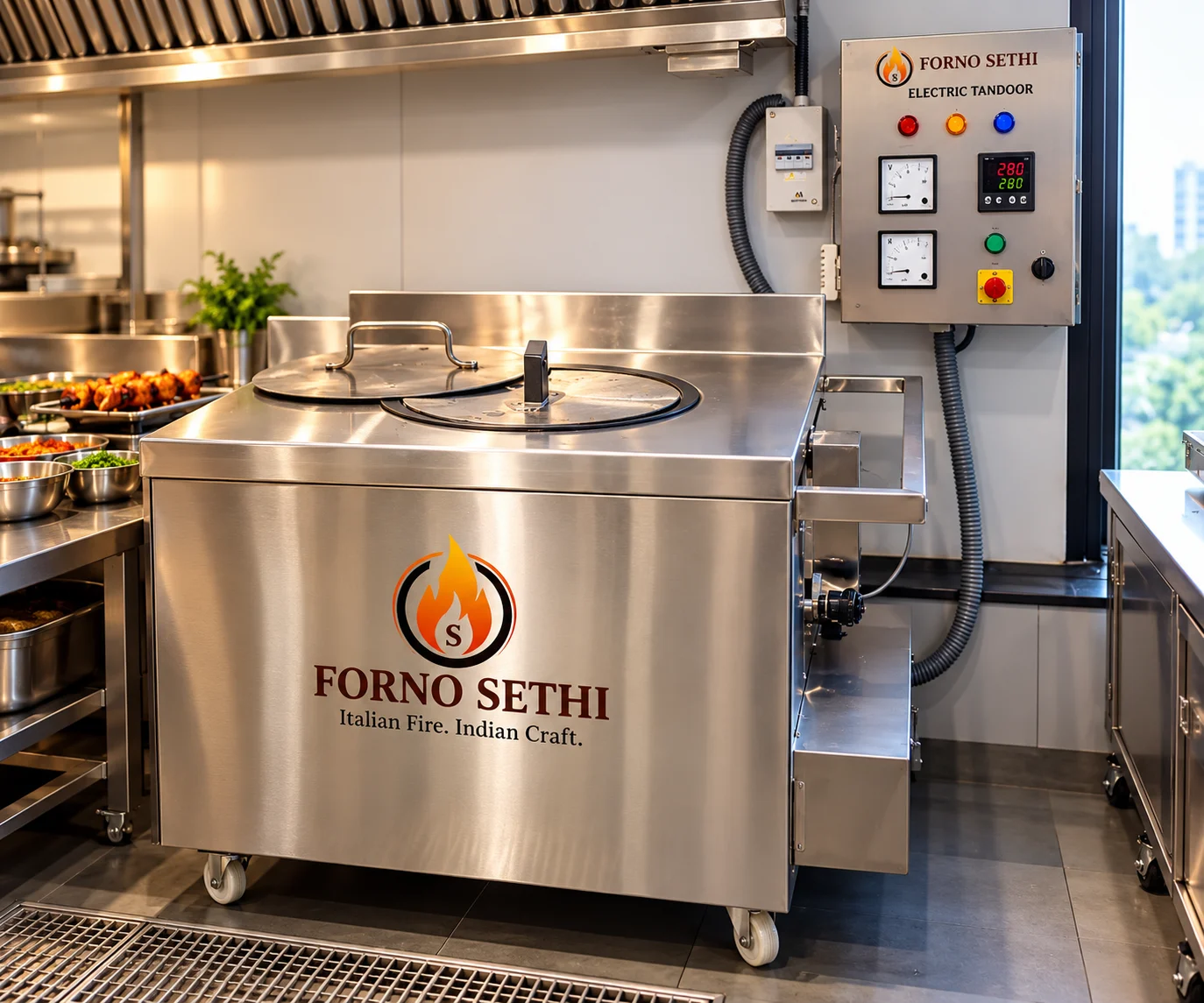
Short answer: a full-size commercial electric tandoor is a heavy electrical load. Our 12 kW model has twelve 1 kW heaters, so at full power it uses 12 units (kWh) of electricity per hour and draws about 16 amps on each phase of a 3-phase supply. It needs a proper 3-phase connection with sufficient sanctioned load; it will not run on an ordinary single-phase domestic line.
By the Forno Sethi team, Burari, Delhi. Last updated: 22 October 2026. Reading time: about 6 minutes.
Restaurant owners usually ask the price first and the load last. Ye ulta hai: pehle ye check karo ki aapki kitchen me tandoor chalane layak bijli hai ya nahi, warna delivery ke baad dikkat aati hai.
What does “12 kW” actually mean?
kW (kilowatt) is the rate at which the heaters use power. One kilowatt running for one hour uses one unit of electricity (1 kWh), which is the unit on your electricity bill. So 12 kW running for one hour uses 12 units, if all heaters are on the whole time.
Our commercial electric tandoor has 12 nichrome heating elements of 1 kW each, fitted around a clay-lined chamber of 500 mm x 650 mm. The temperature range is 100 to 500°C, controlled by a PID controller.
Will it use 12 units every hour?
Not always. The heaters run flat out while the tandoor heats up. Once it reaches the set temperature, the controller switches the heaters on and off to hold it there, so the average use while cooking is lower than 12 kW. How much lower depends on the set temperature, how often the lid is opened, the room temperature and how many items you cook. We do not quote a fixed figure, because it changes from kitchen to kitchen. Check your own meter over a normal service day to get the real number. Our running cost guide shows how to turn that into rupees.
Single phase vs 3-phase: why it matters
Current (amps) depends on power and voltage. For a heater load on a 3-phase supply:
Current per phase = Power (W) / (1.732 x Line voltage)
| Supply | Calculation for 12,000 W | Approx. current |
|---|---|---|
| 3-phase, 415 V | 12,000 / (1.732 x 415) | about 16.7 A per phase |
| 3-phase, 440 V | 12,000 / (1.732 x 440) | about 15.7 A per phase |
| Single phase, 230 V | 12,000 / 230 | about 52 A on one line |
The 3-phase figures are simple calculations for resistive heaters. The single-phase row shows why this size of tandoor is not meant for a domestic connection: 52 A on one line is far beyond ordinary home wiring and meters. Our rated figure is about 16 A per phase on a 440 V, 3-phase supply.
Why a small “electric tandoor” often disappoints
We tried electric tandoors from several vendors before settling on one commercial model. Many small units use only a few kW to be sold as “home” or “light load” tandoors. A clay chamber of commercial size needs enough power to heat the clay and then recover its heat when you open it and load cold dough. With too few kW, the tandoor heats slowly, loses heat during service and gives pale naan. If a seller offers a full-size chamber with a very low kW rating, ask how it holds temperature during a busy service.
Checklist before you order an electric tandoor
- 3-phase connection: confirm you have it at the tandoor location, with a spare circuit for this load.
- Sanctioned load: add 12 kW to your existing kitchen load and check it against the sanctioned load on your commercial connection. Exceeding it can mean penalties or a tripped supply.
- A licensed electrician: the cable size, MCB or breaker rating, and earthing must be decided and installed by a licensed electrician for the full load, with margin above 16 A per phase.
- Earthing and a proper switch: a heavy heater load needs a dedicated, earthed supply, not a shared socket.
- Generator or inverter backup: a generator must be sized for the whole kitchen load with margin. Ask your electrician; do not guess.
- Ventilation: an electric tandoor has no flame or fuel smoke, but it still gives off heat and cooking fumes. Plan an exhaust hood.
- Floor and space: the tandoor weighs about 300 kg, so check the floor and the route to the kitchen.
Electric vs gas: which suits you?
Electric is clean, with no gas cylinder handling and easy temperature control. It needs the right electrical infrastructure and its cost depends on your tariff. Gas runs without a heavy electrical load. We compare all three fuels in gas vs charcoal vs electric tandoor.
Frequently asked questions
Can a 12 kW electric tandoor run on single phase?
No. It needs a 3-phase supply. On a single 230 V line it would draw about 52 A.
How many units does it use per hour?
At full power, 12 units. Once it reaches temperature it uses less, because the controller cycles the heaters. Your actual figure depends on how you use it.
Does an electric tandoor need a chimney?
It has no combustion exhaust, but it produces heat and cooking smoke from the food, so a normal commercial kitchen exhaust is still advisable.
Can I run it on a generator?
Only if the generator is sized for the total load, with margin. Ask your electrician or generator supplier to size it.
Want to check your kitchen before ordering?
See the 12 kW commercial electric tandoor with full specifications, or message us on WhatsApp with your city and supply details.

One thought on “Electric Tandoor Power Consumption: kW, Units per Hour and 3-Phase Load Explained”