
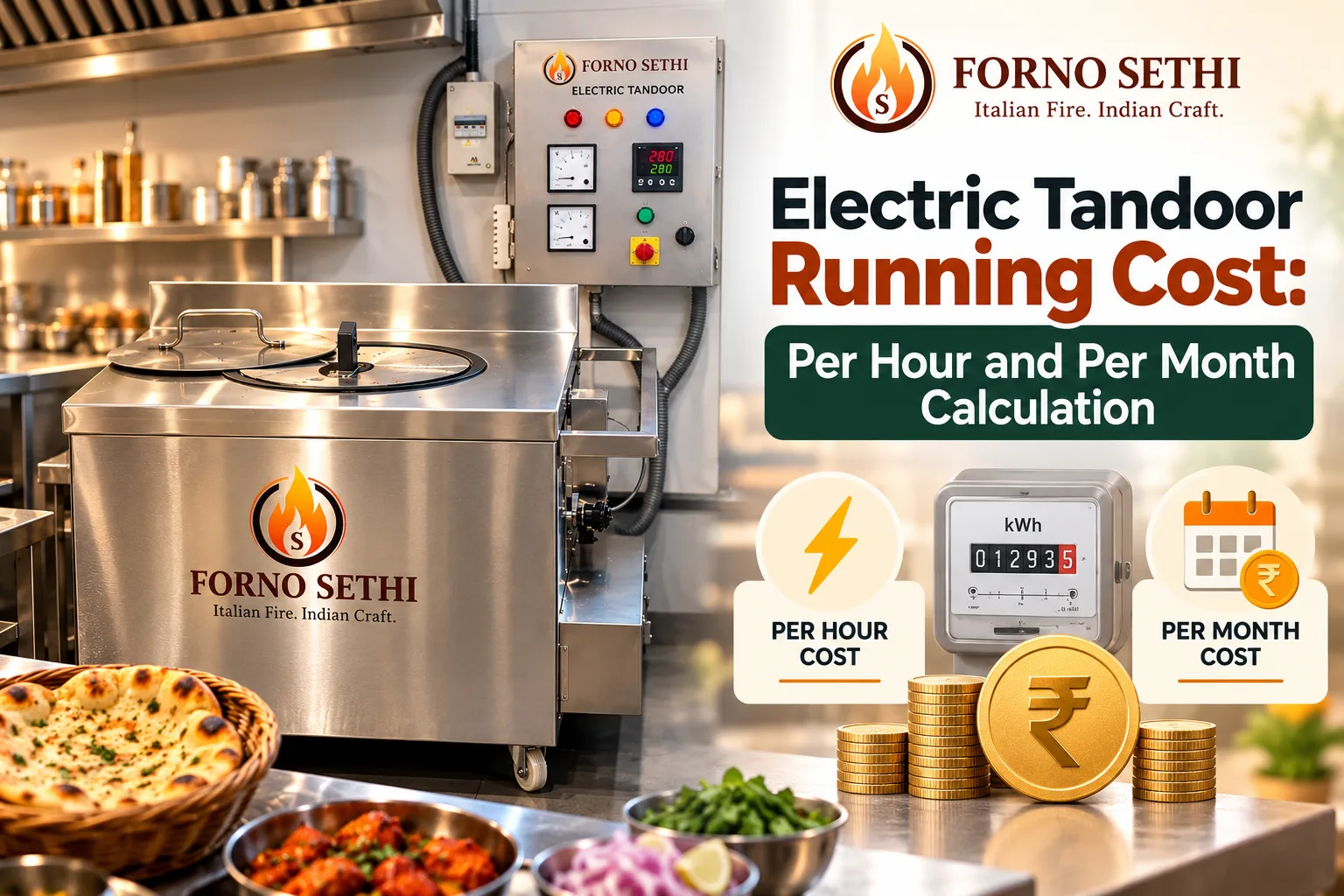
Short answer: running cost = units used x your tariff per unit. A 12 kW electric tandoor uses 12 units for each hour at full power, which is Rs 84 to Rs 132 per hour at tariffs of Rs 7 to Rs 11 per unit. In real use the heaters cycle on and off, so the average is lower. Use the worked examples below with your own tariff and hours.
By the Forno Sethi team, Burari, Delhi. Last updated: 22 October 2026. Reading time: about 6 minutes.
Bhai, tandoor ka bill kitna aayega? Ye sawaal har restaurant wala puchta hai. Seedha formula samajh lo, phir apne tariff se khud nikal lo.
The formula
Units used = Power (kW) x Hours x Duty
Cost = Units x Tariff (Rs per unit)
Duty means the share of time the heaters are actually on. At full power it is 100% (or 1.0). While holding temperature, the controller switches the heaters on and off, so the duty is lower. We have not published a measured figure, because it depends on your set temperature, door openings and kitchen. Treat the duty in the examples as an assumption, and check your own meter to replace it.
Cost per hour at full power (12 kW)
| Tariff per unit | Cost for 1 hour at full power |
|---|---|
| Rs 7 | 12 x 7 = Rs 84 |
| Rs 9 | 12 x 9 = Rs 108 |
| Rs 11 | 12 x 11 = Rs 132 |
This is the upper limit for one hour. The real figure while cooking is usually lower because of cycling.
Example: a month of restaurant use
Assume the tandoor is used 6 hours a day for 26 days, and the heaters average 60% duty (an assumption for illustration).
Units = 12 kW x 6 hours x 26 days x 0.6 = about 1,123 units
| Tariff per unit | Approx. monthly cost |
|---|---|
| Rs 7 | about Rs 7,860 |
| Rs 9 | about Rs 10,110 |
| Rs 11 | about Rs 12,350 |
Change the hours, days or duty to match your kitchen. If you run it for 3 hours a day, the cost roughly halves.
What your bill adds on top
Commercial electricity bills usually include more than the per-unit rate: fixed or demand charges, fuel surcharges, duty and taxes. Your average cost per unit on the bill is a better number than the headline tariff. Divide your total bill by the total units used and use that figure in the formula.
How to compare with gas
Use the same method for gas, with your own numbers:
Gas cost per hour = Cylinder price / Hours one cylinder lasts in the tandoor
Note how long a cylinder lasts in your own service, divide the price you pay by those hours, and compare with the electric cost per hour. Gas prices change often, so we do not quote one here. Also count what is harder to put in rupees: cylinder handling and storage, temperature control, cleaner air in the kitchen and the electrical connection needed for electric. Our fuel comparison covers the other points.
How to keep the electric bill down
- Heat up only when needed. Switch on shortly before service, not hours before.
- Keep the lid on between batches. Every opening drops the temperature and makes the heaters work harder.
- Cook in full batches instead of one or two items at a time.
- Use the right set temperature. You do not need the maximum for everything. Our controller allows 100 to 500°C.
- Check your tariff plan. Some commercial connections charge differently at different times of day.
- Keep the insulation and chamber in good condition. Damaged insulation wastes heat.
Read how much power the tandoor draws in electric tandoor power consumption.
Frequently asked questions
How much does it cost to run an electric tandoor for one hour?
At full power, 12 units. At Rs 9 per unit that is Rs 108. It is usually lower in practice, once the heaters cycle.
Is electric cheaper than gas?
It depends on your electricity tariff and your gas price. Use the two formulas above with your own numbers.
Does a bigger tandoor cost more to run?
Generally yes, because more heater power and more clay mean more energy to heat and hold temperature.
Where can I see the full specifications?
On the electric tandoor page.
Want help estimating for your kitchen?
Message us on WhatsApp with your daily hours and tariff.
